How to Pursue Growth That Endures: A Practical Guide to Long-Term Personal and Professional Development

Growth isn’t just about ambition — it’s about endurance. Too many careers collapse under the weight of constant acceleration, where “more” becomes the enemy of progress. Real development isn’t measured by how fast you climb, but by how well you sustain the climb. Sustainable growth is the art of evolving without wearing downward, expanding your capability while protecting your clarity, energy, and purpose.
Key Insights
● Consistency beats intensity; small, repeatable habits create long-term gain.
● Growth without grounding leads to burnout; structure provides safety.
● Aligning personal purpose with career goals prevents aimless effort.
● Reflection and rest are not interruptions, they’re part of progress.
● Relationships amplify growth when built on mutual trust and shared value.
Reframe Progress: From Performance to Purpose
Sustainable development begins with redefining what “progress” means. Many professionals chase milestones—promotions, income goals, public validation—yet overlook alignment. Purpose-led growth replaces “What should I do next?” with “What’s worth sustaining over time?”
When career goals are backed by personal values, progress becomes self-renewing. You stop forcing motivation and start cultivating momentum. It’s the shift from pressure-driven growth to purpose-driven evolution.
Foundations for Long-Term Development
True longevity in your professional life requires intentional systems that balance learning, recovery, and self-awareness.
● Protect your focus: Eliminate unnecessary complexity from your day.
● Learn cyclically; alternate between deep skill-building and reflection.
● Celebrate recovery as a skill, not a reward.
● Keep curiosity alive by diversifying what you learn.
● Redefine achievement through progress quality, not speed.
Each of these anchors ensures that growth doesn’t outpace sustainability.
How to Keep Moving Forward Without Losing Energy
Here’s a checklist you can use to maintain growth rhythms without exhaustion creeping in:
● Reassess your core motivators monthly; keep them updated to your current reality.
● Prioritize fewer goals but tie each to measurable learning outcomes.
● Track your emotional energy daily to identify stress patterns early.
● Protect focus hours and block “no-meeting” recovery time.
● Rotate between input (learning) and output (execution) cycles.
● Build a quarterly pause; audit what’s working and what’s not.
● Treat rest as strategic preparation, not downtime.
Why Trust-Based Networking Protects Your Energy
Networking isn’t about accumulating contacts, it’s about building ecosystems of support that make growth less solitary and more sustainable. Focusing on creating trusting relationships enables shared momentum; each connection becomes a stabilizing force rather than a drain. When people invest in mutual value, growth feels lighter and more collaborative.
These networks act as cognitive and emotional buffers. You gain access to shared insights, practical shortcuts, and accountability loops that sustain progress. In the long run, collaboration reduces burnout because you’re no longer carrying the full weight of ambition alone.
Why Sustainable Wins the Long Game
Below is a practical comparison to help you identify whether your growth approach leans toward short-term output or long-term impact.
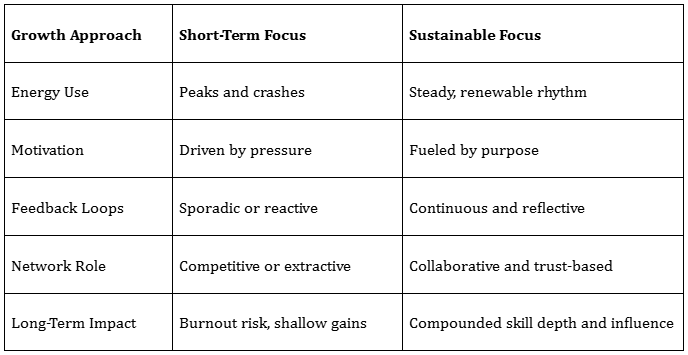
The sustainable column wins not by speed but by endurance, the mark of professionals who grow without collapsing.
Turn Daily Habits into Compounding Growth
Micro-actions define the long-term curve of your career. Instead of chasing major reinventions, build modular habits: five minutes of reflection, a morning of skill reinforcement, a weekly learning note. Each small behavior signals consistency to both your peers and your future self.
When systems, not emotions, drive progress, you achieve something rare: growth that doesn’t require constant willpower. You build compounding rhythm, not constant restart cycles.
FAQ
1. How can I keep advancing without feeling like I’m always behind?
Shift from comparison to calibration. Define metrics of progress that match your unique season of life, not someone else’s timeline. Consistency in your lane creates faster compound results than chasing endless external benchmarks.
2. What’s the best way to maintain growth when I’m overwhelmed by work?
Start by pruning, not adding. Sustainable development often begins by removing low-value commitments. Simplifying your obligations reclaims focus and energy, making space for meaningful advancement without mental overload.
3. How do I invest in my career without losing personal time?
Treat your time like a portfolio; balance effort between income-generating work, learning, and recovery. Protect personal rituals as fiercely as deadlines. Long-term career health depends on non-negotiable personal capacity.
4. What if I lose motivation halfway through a goal?
Motivation fades, systems endure. Revisit whyyou started, reconnect with peers who can reenergize your focus, and simplify the next step. The key is not to restart the journey but to re-engage the reason behind it.
5. How do I know if my professional growth is sustainable?
Look for patterns of renewal, not exhaustion, after periods of challenge. If you can recover quickly, stay curious, and maintain clarity, your system is sustainable. True progress leaves you energized, not empty.
6. When should I seek mentorship or outside help?
Seek guidance when your growth plateaus or you’re repeating old patterns. Mentors compress your learning curve and expand your perspective. Asking for help isn’t a weakness, it’s a multiplier of long-term capability.
Conclusion
Sustainable personal and professional development is not a single breakthrough, it’s a lifetime of calibrated effort. The professionals who thrive aren’t those who never slow down, but those who know when and how to pause. When you balance systems, energy, and relationships, growth stops being a sprint and becomes a state, one that lasts.
Contributor author: Justin Wiggs
Justin Wigg BUSINESSHUBCITY.COM
Image via https://www.freepik.com/
Send a Message
Do you want to live to your full potential and be the person God made you to be? Then Empower Global Coaching is here for you. My mission is to help you live a happy and fulfilled life.